



Beyond Go-Live: What Defines a Dependable Technology Partner?
- Oct 22, 2026
- Satya Prakash
- Tech Strategy, Web & App Development
- 10 Mins. Read
Why successful technology partnerships are measured not only by what gets delivered, but by the confidence they create over time.
A software project can consume months of development effort, reach an advanced stage of completion, and still leave a business uncertain about when it will become operational.
Most of the functionality may already exist, and significant investment may have been made. Yet the project remains unfinished, leaving the anticipated business value out of reach.
At that point, the challenge extends beyond technical delivery. It becomes a question of accountability, confidence, and whether the existing partnership can bring the project across the finish line.
Businesses naturally evaluate technology partners through technical expertise, portfolios, commercial proposals, and delivery commitments. These are important, but they reveal only part of the picture.
The real strength of a partnership often becomes clearer after go-live, when systems enter daily use, requirements evolve, and unexpected challenges test earlier decisions.
A successful launch demonstrates the ability to deliver. A dependable partnership demonstrates the ability to remain valuable as the business evolves.
When the Final 10% Becomes the Hardest Part
Several years ago, a business approached W3care with a software project that was approximately 90% complete but still struggling to launch.
The original development timeline was six months. Much of the core functionality had been built, but the remaining work was proving increasingly difficult to complete.
Even relatively small feedback requests were taking longer than expected. Fixing one issue sometimes introduced another, creating repeated rounds of changes without bringing the platform meaningfully closer to launch.
Communication had also become a concern. Response times were slowing, agreed timelines were slipping, and the client was increasingly uncertain about when the project would be ready.
Three additional months passed beyond the original schedule. By then, the challenge was no longer simply unfinished development work. The client had lost confidence in the delivery process and decided to find another technology partner.
Three Weeks to Go-Live
When W3care became involved, our priority was to understand the existing system rather than immediately propose major changes.
During the first week, our team familiarized itself with the application, reviewed existing functionality and outstanding issues, and took ownership of the remaining work. Understanding what had already been developed was essential before deciding what needed attention.
The second week focused on resolving the issues preventing launch. With a clearer understanding of the application, the team addressed most of the outstanding blockers through focused development and short turnaround times.
Given the client's earlier experience, particular attention was paid to avoiding situations where resolving one issue introduced problems elsewhere.
During the third week, attention shifted toward rigorous quality checks, resolving remaining issues, and preparing the platform for launch.
The client's involvement was equally important. Timely feedback and approvals helped maintain momentum, while growing confidence in the team's progress made collaboration more effective.
By the end of the third week, the platform had successfully gone live.
That was an important milestone, but the relationship did not end there. More than three and a half years later, W3care continues to support the same platform as the client's requirements evolve. During that time, the client has also referred three other businesses to us.
The experience highlights a distinction that is easy to overlook: completing most of an application and bringing it into reliable operation are not necessarily the same challenge.
The final stages require clear ownership, careful testing, responsive communication, and timely decisions from everyone involved.
Not every delayed project can be recovered in three weeks. The condition of the existing system, technical dependencies, and remaining scope all influence what is realistically possible.
For this client, the three-week turnaround restored progress. The years of continued collaboration helped establish lasting confidence.
The Four Tests of a Dependable Technology Partner
Technology partnerships vary considerably. A startup developing its first product faces different challenges from an established business maintaining complex applications.
Yet four qualities consistently influence whether a technology relationship creates lasting value.
At W3care, we view them as four practical tests: Delivery, Accountability, Continuity, and Professional Judgment.
Together, they provide a framework for evaluating technology partners beyond their immediate development capabilities.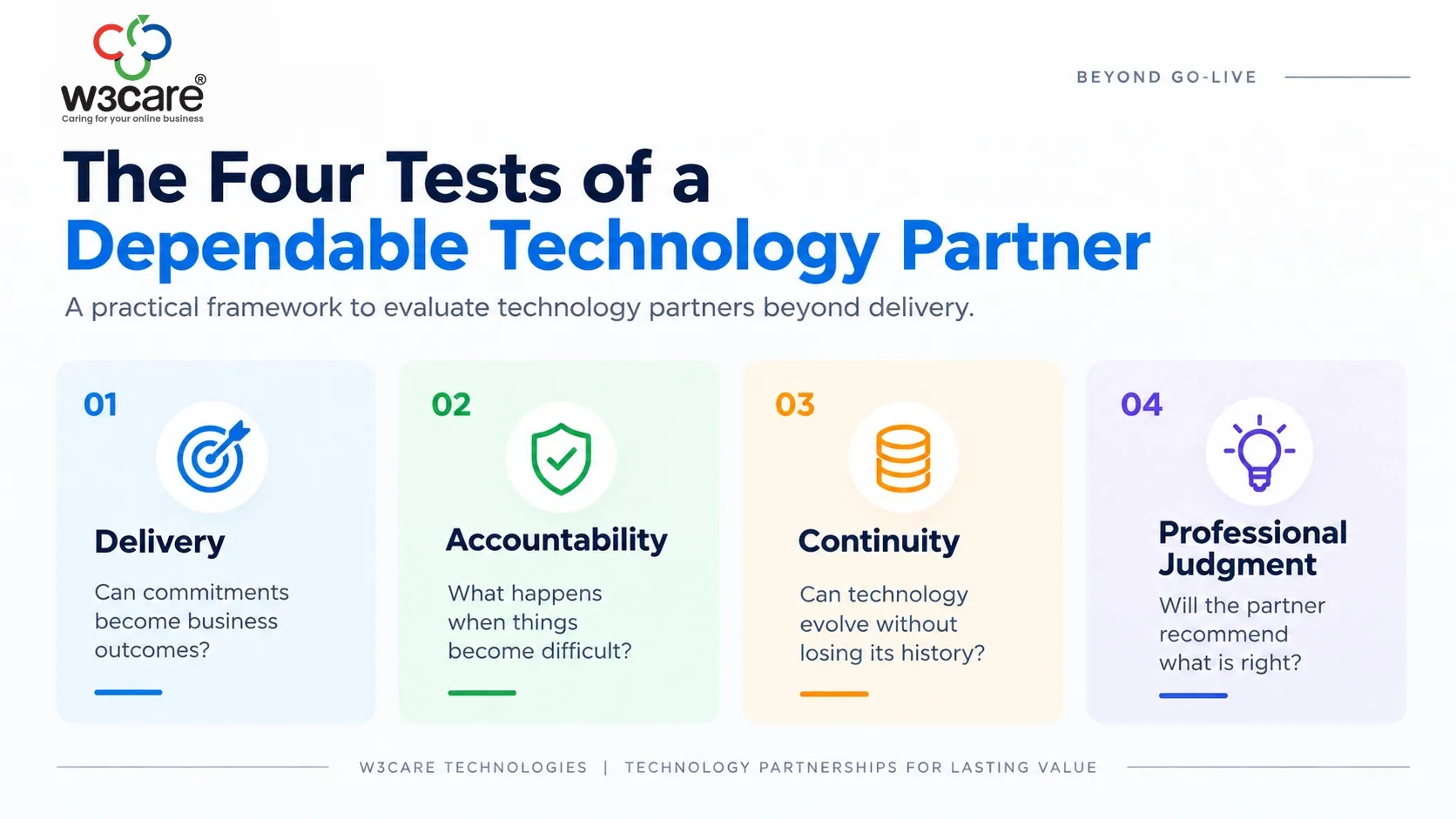
1. Delivery: Can Commitments Become Business Outcomes?
Delivery is the most visible test. Can the partner understand requirements, make appropriate technical decisions, manage dependencies, and produce a working solution within realistic constraints?
Technical expertise, planning, testing, and disciplined execution matter. However, completing development tasks isn't necessarily the same as delivering business value.
A website may meet its specifications while remaining difficult for its content team to manage. An application may contain the requested functionality but struggle under real operating conditions.
A dependable partner should understand why the technology is being developed, not simply what has been requested. That sometimes means questioning assumptions, avoiding unnecessary complexity, or recommending a phased implementation.
The right solution isn't always a new platform. It may involve improving an existing system or resolving overlooked technical limitations.
Ultimately, delivery should be measured by whether the organization receives technology it can operate confidently and develop further.
2. Accountability: What Happens When Things Become Difficult?
Software development involves uncertainty. Requirements evolve, technical assumptions change, and dependencies introduce unexpected complications.
These challenges don't automatically indicate an ineffective team. What matters is how the partner responds.
Does the team communicate difficulties early, explain their implications, propose practical alternatives, and establish responsibility for the next steps? Or does communication become less frequent precisely when the client needs greater visibility?
Consider an important integration that stops working after a third-party API change. The business needs more than confirmation that someone is investigating. It needs to understand the impact, possible workarounds, next steps, and when another meaningful update can be expected.
Accountability isn't about promising that problems will never occur. It's about handling them openly and responsibly.
Clear communication enables informed decisions. Repeated assurances without measurable progress gradually undermine confidence.
3. Continuity: Can the Technology Evolve Without Losing Its History?
Every software platform accumulates knowledge.
Some exists in source code, documentation, architecture diagrams, and deployment procedures. Much of it, however, exists in the reasoning behind previous decisions.
Why was a particular integration designed that way? Why does the application follow a specific business rule? What constraints influenced its architecture?
When this knowledge is poorly documented or concentrated within a few individuals, even routine changes can become difficult and expensive.
Continuity requires deliberate effort. Businesses should retain appropriate ownership and access to source repositories, hosting environments, deployment pipelines, database documentation, integration configurations, and third-party accounts.
They should also understand how responsibilities would transfer if the development team or technology partner changed.
A structured handover should explain what has been built, how it operates, what dependencies exist, and which unresolved risks require attention.
The objective isn't to make the technology provider indispensable. It's to make the technology sustainable.
4. Professional Judgment: Will the Partner Recommend What's Right?
Technical capability is essential, but sound judgment distinguishes execution from a meaningful technology partnership.
Not every business requirement should automatically result in new development.
Sometimes improving an existing platform is more appropriate than rebuilding it. Sometimes a migration should be postponed until dependencies are understood. Sometimes security, performance, or technical debt should take priority over additional features.
A dependable partner should explain these trade-offs and recommend what best serves the business, even when that advice doesn't immediately generate additional development work.
Professional judgment also involves understanding the organization's resources, operational priorities, and long-term objectives.
When delivery, accountability, continuity, and judgment consistently meet expectations, trust develops through experience rather than promises.
How Business Leaders Can Evaluate a Technology Partner
These four qualities become most useful when translated into evidence. Whether choosing a new development company or reviewing an existing partnership, business leaders should look beyond presentations and promises.
Test | Evidence worth requesting |
| Delivery | Acceptance criteria, testing results, completed milestones, release procedures, and relevant project references |
| Accountability | Escalation procedures, incident communication, change management, and examples of handling unexpected challenges |
| Continuity | Technical documentation, repository ownership, infrastructure access, deployment procedures, and handover plans |
| Professional Judgment | Examples where the partner advised against an unnecessary rebuild, feature, or migration; documented trade-offs; and business-focused recommendations |
Five questions can help establish expectations:
1. What happens after launch? Clarify responsibilities for maintenance, security updates, monitoring, hosting, and future enhancements.
2. Who owns the technology and its knowledge? Establish ownership, access rights, documentation responsibilities, and transition arrangements.
3. How are unexpected difficulties managed? Ask for examples involving delays, changing requirements, or production incidents.
4. Will the partner challenge unsuitable decisions? Look for thoughtful recommendations rather than unquestioning execution.
5. How will success be evaluated over time? Agree on meaningful measures for reliability, responsiveness, maintainability, and business outcomes.
These questions move the conversation beyond what a provider promises toward how the partnership will operate.
Why Go-Live Changes the Relationship
Before launch, most discussions focus on building the technology. After launch, that technology becomes part of daily business operations.
It supports customers, employees, workflows, and operational commitments. Performance, security, availability, and changes to live systems require continuing attention.
This is where earlier architectural decisions begin revealing their long-term consequences.
Poorly designed integrations can create recurring problems. Inadequate documentation can delay enhancements. Unsupported software may introduce security and compatibility risks.
Thoughtful engineering decisions, by contrast, can make future development more predictable and less disruptive.
For business-critical platforms, maintenance is part of technology strategy, not merely a collection of support tickets.
The appropriate arrangement depends on the platform's complexity, operational importance, and business risks. Some organizations require continuous monitoring and defined service levels; others need periodic upgrades or specialist assistance.
A dependable partner helps establish a support model that protects the investment without creating unnecessary cost or complexity.
A Partnership Should Create Confidence, Not Dependency
There's an important difference between clients who continue working with a technology partner because they value the relationship and those who remain because changing providers would be too difficult.
The first reflects confidence. The second may indicate dependency.
A healthy partnership should strengthen an organization's technical foundations and preserve its ability to make independent decisions.
That may mean documenting an application so another team can understand it, recommending an upgrade before unsupported software becomes a risk, or acknowledging when a different technology would better serve the business.
Not every engagement needs to last for years. Some projects have clearly defined objectives and a natural conclusion.
But every engagement should leave the organization with functioning technology, appropriate knowledge, clear ownership, and a practical understanding of what comes next.
The Real Measure of a Technology Partnership
A successful launch deserves recognition. It represents planning, investment, collaboration, and substantial technical effort. But it isn't the final measure of the relationship.
That becomes clearer through the decisions and challenges that follow: how knowledge is preserved, difficulties are communicated, systems are maintained, and changing business requirements are addressed.
At W3care, our experience supporting organizations through development, project transitions, modernization, and ongoing support has reinforced a consistent perspective.
The strongest technology partnerships aren't those in which clients become dependent on a provider. They're the ones in which clients become more confident in their systems, more informed about their decisions, and better prepared for change.
A successful launch is proof of delivery.
What happens afterward is proof of the partnership.
Is Your Technology Project Struggling to Reach the Finish Line?
Whether you're dealing with a delayed software project, planning a development handover, or concerned about the long-term sustainability of an existing platform, getting an independent technical perspective can help clarify the next steps.
Have a project that's stalled near the finish line? Talk to W3care about a project assessment.
- Can Machines Understand Your Business? The Question Every Leadership Team Now Needs to Answer
- Beyond the Purchase Price: A Leadership Framework for Technology Decisions
- WordPress 7.1 Is Here: What Businesses Should Know Before Upgrading
- DDoS Attacks Are Getting Faster. Is Your Business Ready for the First 10 Minutes?
- Digital Independence: The Competitive Advantage Most Businesses Overlook
- Your Website Is Getting Traffic. Why Isn’t It Generating More Business?
- Your Website Is a Business Asset
- Still Running PHP 7.4? Upgrade Before It Costs Your Business
- How Businesses Are Being Targeted by Modern Cyber Fraud in 2026
- W3care Recognized as a Top Firm by 50Pros (Spring 2026)