

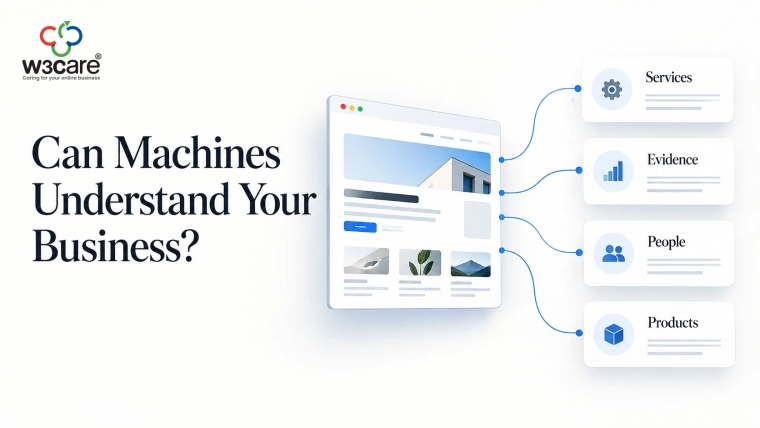
Can Machines Understand Your Business? The Question Every Leadership Team Now Needs to Answer
- Oct 09, 2026
- Satya Prakash
- Technology Strategy, AI & Automation
- 7 Mins. Read
AI assistants and agents are now researching and shortlisting vendors on behalf of your buyers. How accurately they understand your business is fast becoming a leadership issue.
Over my career in technology, I have watched several platform shifts reshape how businesses reach their customers: the commercial web, search, mobile and cloud.
Each quietly rewrote the rules for companies that weren't paying attention. AI-driven discovery is the next one, and it is already under way.
For two decades, digital strategy has rested on one assumption: people visit websites.
That still holds, but it is no longer the whole story. Your website is now also being read and interpreted by machines, from search engines and AI assistants to autonomous agents acting on behalf of buyers.
So leadership teams need a second question alongside "Can our customers understand our website?"
It is this: "Can machines understand our business well enough to represent it?"
AI now sits between you and your buyer
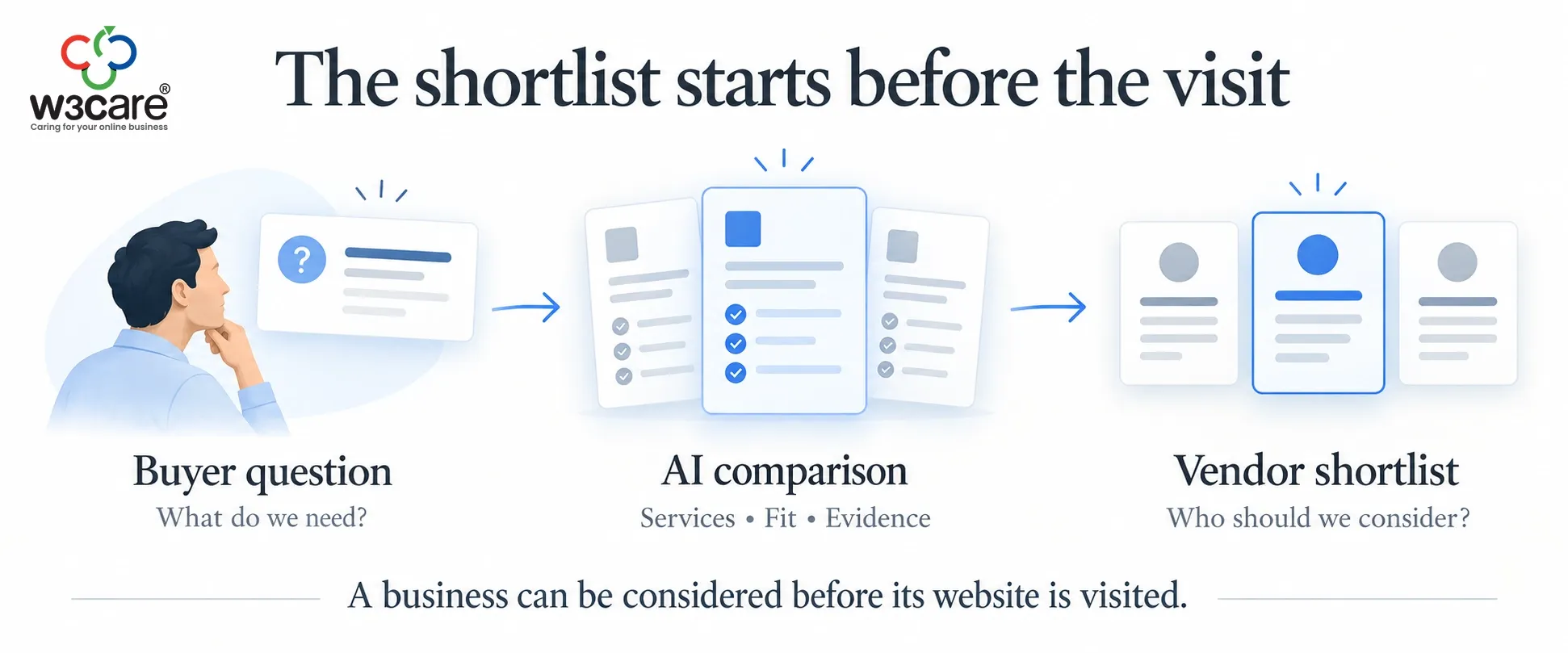
A procurement lead or department head can now ask an assistant to compare providers, explain how platforms differ, or produce a vendor shortlist, all before a single sales conversation.
Anyone who has sat on a selection panel knows what that means. The shortlist is where most deals are won or lost. If AI is shaping that shortlist, your website and digital presence may already have influenced the decision before the buyer visits your website or speaks with your sales team. Your website is no longer just a destination. It is one of the most important first-party sources other systems use to understand who you are, what you do and whether you belong in the conversation.
Readable is not the same as understandable
I have reviewed many award-worthy corporate websites that still left a machine guessing about what the company actually does.
A human visitor infers a firm's specialism from imagery, case studies and tone. An AI system needs it stated: which services, for which industries and regions, using which technologies, backed by which evidence. For an AI system to represent the firm reliably, that information needs to be current, consistent and supported by credible evidence. In commerce the bar is higher still, because an agent needs exact answers on variants, live pricing, stock, delivery and returns.
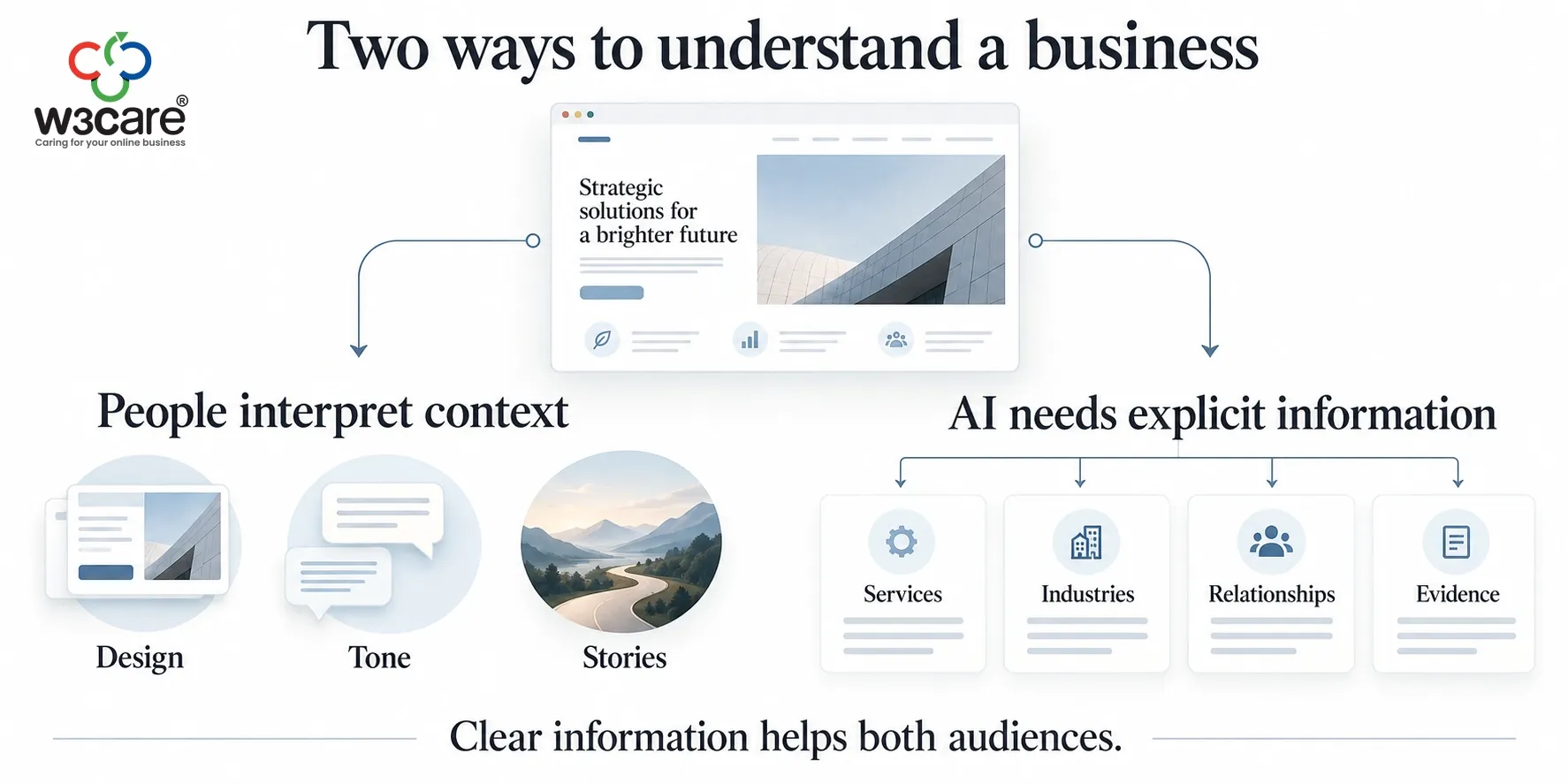
The lesson for leadership is simple. If your positioning depends on a reader inferring it, machines are far more likely to miss it or get it wrong.
A business architecture issue, not an SEO tactic
Many organisations will hand AI visibility to marketing as "the next chapter of SEO". I saw the same instinct with mobile and social, and it underestimates the shift.
In commerce, an AI agent needs to understand and potentially act on a whole chain:
product → variant → price → availability → delivery → policy → checkout. That runs through product data, commerce platforms, APIs, permissions and transaction systems. The market is already moving: Shopify, for instance, now exposes structured product, pricing and inventory data to AI platforms as part of its agentic commerce offering.
The principle applies to every sector: machines can interpret business information more reliably when it is explicit, structured and accessible. And once agents move from recommending to transacting, authentication, API design and governance become CTO and CISO concerns, with direct revenue and brand stakes for the CEO and CMO.
Influence without the visit
This is the shift I expect boards and CMOs to find hardest. We have long reported digital performance along one funnel: visibility → click → visit → conversion. AI makes that funnel less complete.
Imagine a CIO asks an assistant which partners could handle a complex CMS migration. The AI may weigh up ten firms and name three; the CIO visits one. All ten firms may have been evaluated, yet nine recorded no website visit.
Digital influence can now exist without matching traffic. Dashboards built only on sessions and clicks will increasingly understate how buyers form their views. Leaders will need to ask a new question: are we represented accurately inside AI-driven discovery?
What this means for the CEO, CTO and CMO
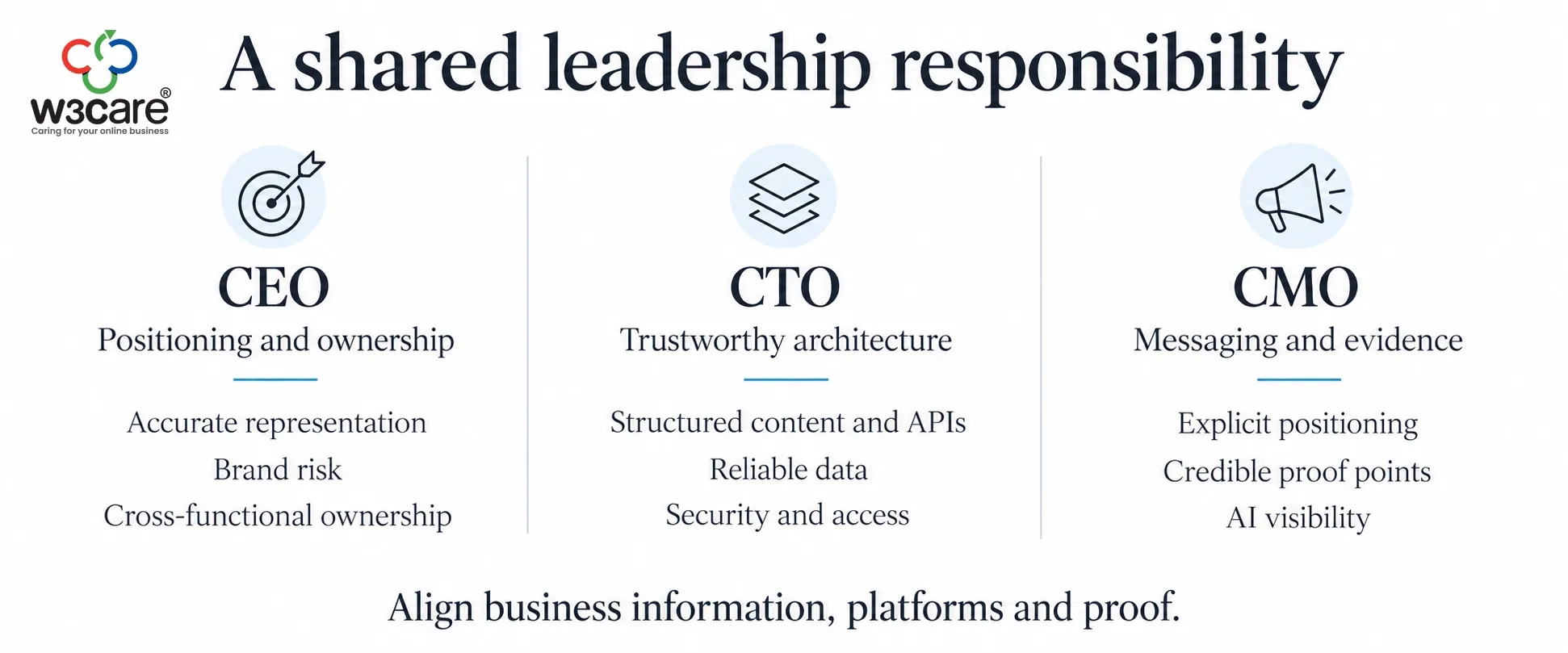
Each leader owns a different part of the problem. The organisations that move well are the ones where these conversations happen together, not in silos.
- CEO: Are we represented accurately where buyers now form opinions?
- CTO: Can our platforms expose trustworthy data and safely support agents?
- CMO: Do our positioning and proof points hold up when AI does the first read?
A practical leadership agenda
This does not mean building a second website for machines. In most cases it means making the existing estate clearer, better structured and more authoritative, which pays back across every audience at once.
- Make critical information explicit. State plainly what you do, for whom, where, and what evidence proves it.
- Structure content around the business. Connect services to industries, technologies, case studies and people; give products clear attributes.
- Use structured data with discipline. Schema markup should mirror what users see, never a hidden layer for bots.
- Set a deliberate policy on automated access. Search, AI retrieval, model training and live agents are different purposes and may deserve different rules.
- Treat information quality as governance. Assign clear ownership for keeping authoritative information current.
- Look beyond pages. Where pricing, inventory or availability change often, feeds and APIs become strategic assets.
- Secure the systems behind the interface. Letting agents act is very different from letting them read. AI access must never come at the cost of security.
Rethinking the CMS
For most of my career, the CMS was treated as a page-publishing tool. That definition is now too narrow. Content must flow to websites, apps, storefronts, portals, APIs and AI interfaces, and when it is locked inside presentation-focused pages, every new channel becomes a costly integration. The durable answer is structured content: services, products, people, locations and case studies modelled as entities with their relationships intact. Content stops being a by-product of web design and becomes an enterprise information asset, capable of serving multiple channels, systems and emerging interfaces.
The website's job is getting bigger
Every platform shift I have lived through came with predictions that the website was finished. They were wrong each time. As AI-generated answers multiply, trustworthy first-party sources may matter more, not less.
What is changing is the website's role: a destination for people, an authoritative source for machines, and potentially an interface for AI agents. No one needs to predict exactly how this unfolds. OpenAI already surfaces public websites in ChatGPT search, commerce platforms are building rails for AI buying, and bot-management providers now separate search crawlers, training crawlers and agents. The direction of travel is clear.
The right response is to double down on fundamentals: clear information, sound architecture, structured content, reliable data and strong security. And to make sure your leadership team is asking the question that now matters most: "Can machines understand our business well enough to represent it accurately?"
Preparing your digital estate for what comes next
At W3care, we increasingly look at website and platform architecture through this wider lens: not only how well a digital experience works for people today, but how clearly its underlying information can be understood, reused and securely accessed across emerging interfaces.
For organisations planning CMS modernisation, ecommerce evolution or broader digital transformation, AI readiness is becoming another important architectural consideration.
Want to understand how prepared your current digital estate is? Talk to the W3care team.
- Can Machines Understand Your Business? The Question Every Leadership Team Now Needs to Answer
- Beyond the Purchase Price: A Leadership Framework for Technology Decisions
- WordPress 7.1 Is Here: What Businesses Should Know Before Upgrading
- DDoS Attacks Are Getting Faster. Is Your Business Ready for the First 10 Minutes?
- Digital Independence: The Competitive Advantage Most Businesses Overlook
- Your Website Is Getting Traffic. Why Isn’t It Generating More Business?
- Your Website Is a Business Asset
- Still Running PHP 7.4? Upgrade Before It Costs Your Business
- How Businesses Are Being Targeted by Modern Cyber Fraud in 2026
- W3care Recognized as a Top Firm by 50Pros (Spring 2026)