

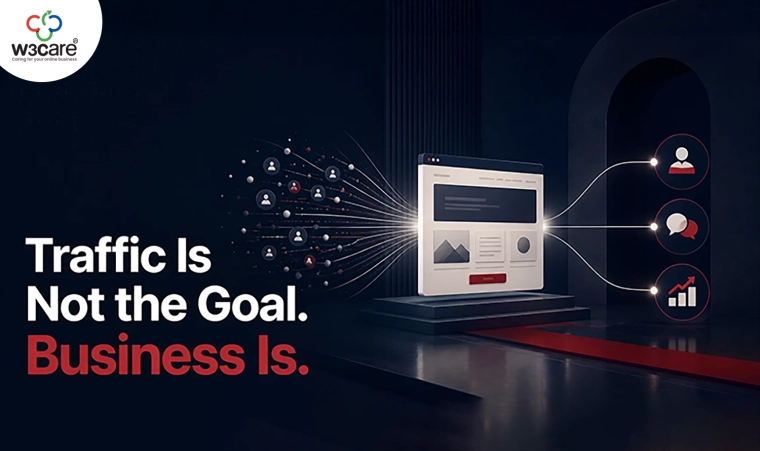
Your Website Is Getting Traffic. Why Isn’t It Generating More Business?
- Aug 05, 2026
- Tarachand
- Web Development, eCommerce, Business
- 7 Mins. Read
Six questions leaders should ask before investing in more website traffic.
The campaign worked. Traffic is up.
But enquiries have barely changed. Sales are not growing at the expected rate. The marketing report shows activity, yet the commercial results tell a different story.
What happens next is predictable. The business considers increasing its advertising budget, publishing more content, or investing further in SEO.
But what if traffic is not the real problem?
If a website is slow, unclear, difficult to trust, or frustrating to use, attracting more visitors will not solve the underlying issue. It may simply send more potential customers into an experience that fails to convert them.
Traffic is an input. Business growth is the outcome.
A commercially effective website should move visitors through four stages:
Attention → Understanding → Confidence → Action
When that journey breaks, marketing becomes less efficient, technology investment delivers less value, and revenue opportunities are lost.
Before spending more to attract visitors, CEOs, CTOs, and Marketing Heads should examine six areas.
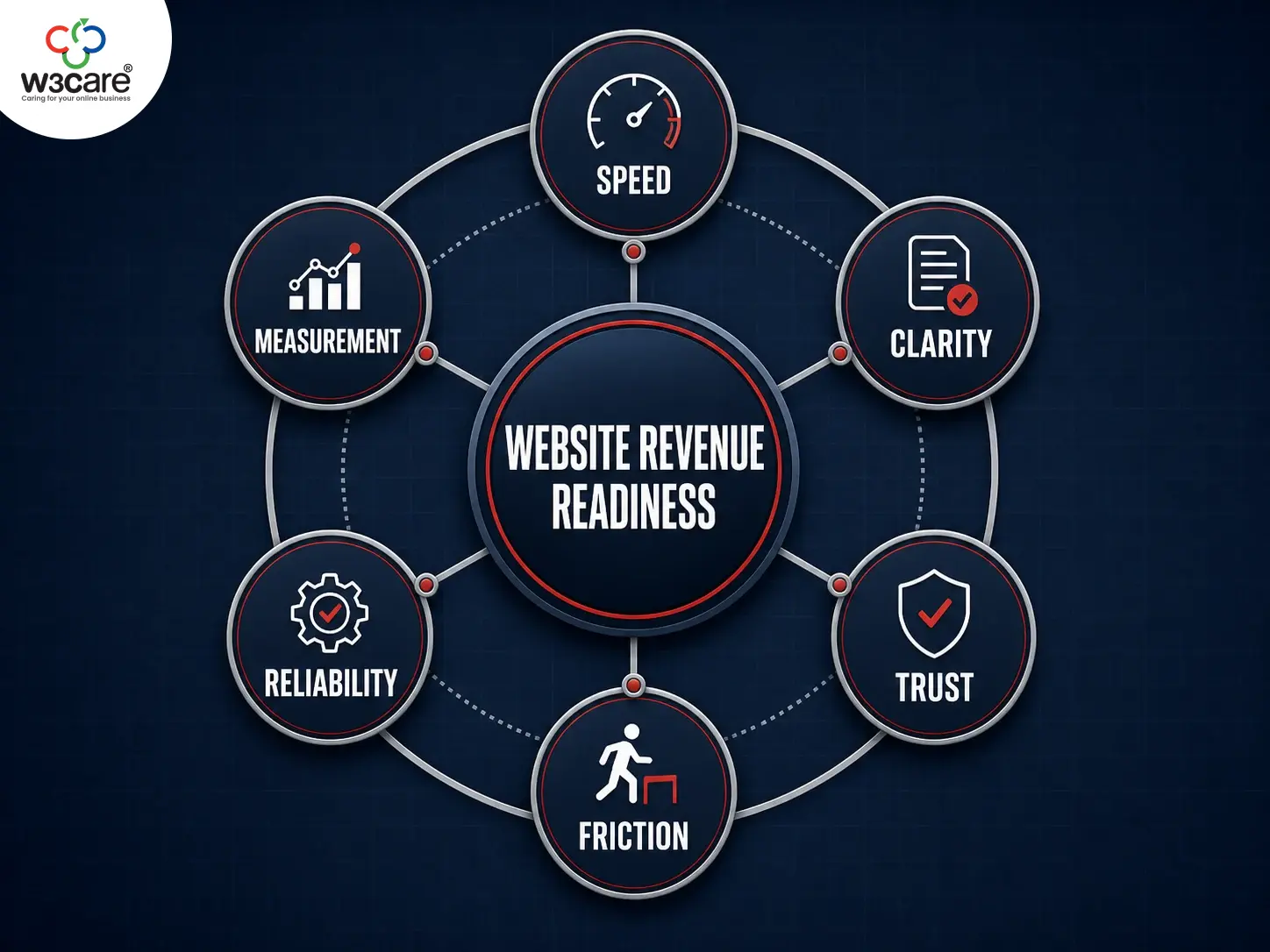
1. Can Customers Reach What Matters Quickly?
Website speed is often treated as a technical concern. Customers experience it differently.
They notice when important content takes too long to appear, when a button responds slowly, or when the page moves unexpectedly as it loads. They do not diagnose the cause. They simply experience hesitation and frustration.
Google’s Core Web Vitals provide useful benchmarks for loading performance, responsiveness, and visual stability. However, achieving a strong score is not the final objective. Google itself explains that good Core Web Vitals do not guarantee high search rankings.
The more valuable question is:
Can customers accomplish what they came to do quickly and confidently?
Performance reviews should therefore focus on commercially important journeys, not only the homepage. Product pages, service pages, search, forms, carts, and checkout all deserve attention.
For a CTO, this is a performance and architecture issue. For a Marketing Head, it affects campaign efficiency. For a CEO, it is a question of whether digital investment is producing value.
2. Can Visitors Understand Your Value?
Many websites are full of information but short on clarity.
They describe technologies, capabilities, features, and processes without quickly answering the customer’s most important questions:
- Is this relevant to me?
- Can this company solve my problem?
- Why should I trust it?
- What should I do next?
Internal teams know their products and services in detail. Visitors do not arrive with the same knowledge or patience.
A strong page begins with the customer’s situation. It explains the value in familiar language, supports its claims, addresses likely concerns, and offers a clear next step.
Clarity does not mean oversimplifying a sophisticated service. It means presenting complexity in an order that helps customers make decisions.
If a visitor must interpret the website before understanding the offer, the business is creating unnecessary distance from the sale.
3. Have You Earned Their Confidence?
Every enquiry, consultation, registration, or purchase requires a degree of trust.
Visitors want to know whether the business is credible, whether it understands their needs, and whether it will deliver what it promises.
A polished design helps, but appearance alone is not proof.
Trust is built through relevant case studies, genuine testimonials, recognized partnerships, clear company information, transparent policies, secure transactions, and realistic claims supported by evidence.
Generic phrases such as “industry-leading” and “best-in-class” often create more scepticism than confidence when they are not supported.
Specificity is more persuasive.
Show the problems your team has solved. Explain how you work. Demonstrate relevant experience. Help customers understand what will happen after they contact you.
The goal is not to remove every perceived risk. It is to give the customer enough confidence to take the next step.
4. Are You Making Customers Work Too Hard?
Friction is any unnecessary effort placed between customer intent and customer action.
It can be an overcomplicated menu, a long enquiry form, forced account creation, an unclear button, hidden delivery information, or an error message that offers no useful direction.
For service businesses, friction often appears in the enquiry journey. Visitors may not know which service to choose, what information to provide, or what will happen after submitting a form.
For eCommerce businesses, including those using Shopify, friction can appear during product selection, shipping, payment, or checkout.
Baymard Institute’s 2025 research reports an average cart-abandonment rate of approximately 70 percent. Some abandonment is natural, but 17 percent of surveyed US online shoppers said they had abandoned an order because the checkout was too long or complicated.
The principle is simple:
Do not ask customers for more information, effort, or commitment than the journey requires.
Every field, popup, page, and decision should earn its place.
5. Does the Experience Work Consistently?
Not every conversion problem is caused by content or design.
A form may appear to submit without delivering the enquiry. A payment option may fail on certain devices. Search may return irrelevant results. Inventory information may be inaccurate. An integration may stop responding.
These failures are easy to miss because they may affect only certain customers, browsers, locations, or payment methods.
A website should not be treated as complete simply because it has been launched.
Digital platforms depend on changing software, browsers, integrations, infrastructure, and security requirements. They need testing, monitoring, and maintenance, along with clear ownership.
For technology leaders, reliability is an operational responsibility. For marketing leaders, it protects campaign performance. For the wider business, it protects customer confidence and revenue.
6. Are You Measuring Business Outcomes?
Traffic tells you how many visits occurred. It does not tell you whether the right people arrived or whether the website helped them move forward.
Leadership teams should look beyond visits and impressions. Depending on the business, meaningful measures may include:
- Qualified enquiries
- Form completion
- Lead quality
- Checkout progression
- Payment failures
- Revenue per visitor
- Repeat purchases
These outcomes should be examined by device, traffic source, page, and customer journey.
A healthy overall conversion rate may conceal a serious mobile problem. A large number of enquiries may appear successful until the sales team reports that most are poorly qualified.
Analytics can reveal where visitors leave. Customer feedback, error logs, usability testing, and conversations with sales or support teams help explain why.
The objective is not to create more dashboards. It is to identify where the business is losing opportunities and decide what to improve.
Six Questions for the Leadership Team
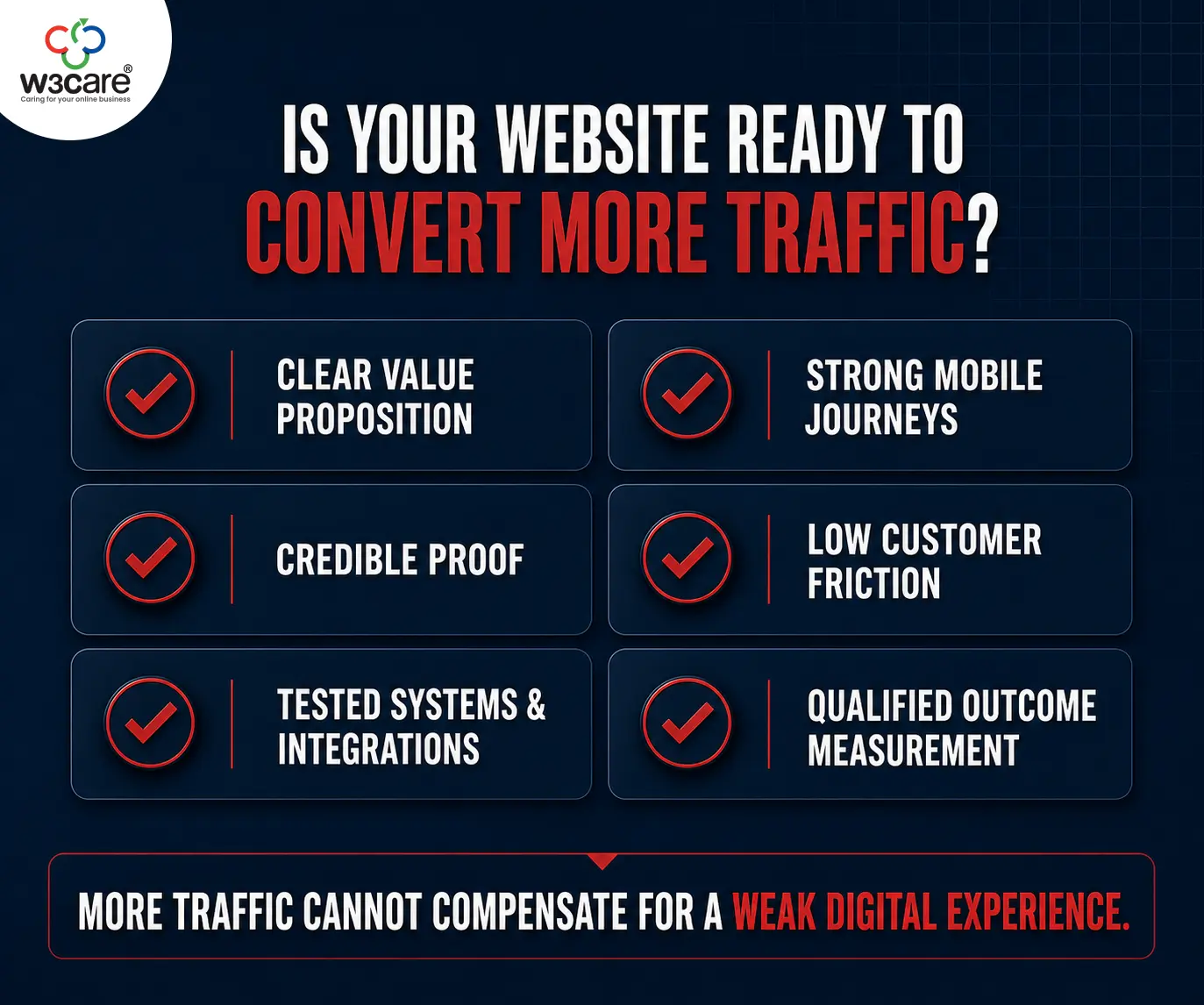
Before increasing your website-acquisition budget, ask:
- Can a first-time visitor quickly understand what we offer?
- Do our most valuable customer journeys perform well on mobile devices?
- Do we provide credible evidence for our most important claims?
- Can visitors enquire or purchase without unnecessary effort?
- Have we recently tested every important form, payment, and integration?
- Are we measuring qualified outcomes rather than traffic alone?
A “no” or “not sure” does not automatically mean the website needs to be rebuilt.
Some problems can be addressed through focused improvements to content, design, performance, or integrations. Others may expose structural limitations that require website redesign, replatforming, or custom web development.
The right approach is to identify the constraint before prescribing the solution.
Before You Invest in More Traffic
SEO, advertising, social media, and content all play important roles. But their commercial impact depends on what happens after the click.
Before spending more to attract visitors, make sure your website is ready to convert the attention it already receives.
A successful website should do more than look modern or generate activity. It should help the right customers understand your value, trust your business, and take the next step with confidence.
That is when a website becomes more than a digital presence.
It becomes business infrastructure.
Is Your Website Losing Opportunities After the Click?
W3care helps businesses identify the performance, user-experience, technical, and conversion issues that prevent website traffic from producing stronger commercial results.
Request a Website Revenue Readiness Review.
We will help you identify what is working, where customers encounter friction, and which improvements deserve priority.
- Beyond the Purchase Price: A Leadership Framework for Technology Decisions
- WordPress 7.1 Is Here: What Businesses Should Know Before Upgrading
- DDoS Attacks Are Getting Faster. Is Your Business Ready for the First 10 Minutes?
- Digital Independence: The Competitive Advantage Most Businesses Overlook
- Your Website Is Getting Traffic. Why Isn’t It Generating More Business?
- Your Website Is a Business Asset
- Still Running PHP 7.4? Upgrade Before It Costs Your Business
- How Businesses Are Being Targeted by Modern Cyber Fraud in 2026
- W3care Recognized as a Top Firm by 50Pros (Spring 2026)
- The Hidden Cost of Cheap Web Development