



Digital Independence: The Competitive Advantage Most Businesses Overlook
- Aug 13, 2026
- Tarachand
- Cybersecurity
- 6 Mins. Read
An Independence Day reflection on technology, resilience, and the freedom to adapt.
Most businesses do not lose their independence overnight.
It disappears quietly.
One undocumented deployment.
One legacy application that nobody wants to upgrade.
One critical integration understood by only one person.
One postponed maintenance window after another.
None of these decisions seem significant when they are made. They are often practical, well-intentioned choices made to keep projects moving and customers happy.
Years later, however, those same decisions begin to shape something far more important than the technology itself. They determine how quickly a business can respond to change, recover from disruption, adopt new opportunities, or simply continue operating with confidence.
This Independence Day, while we celebrate the freedom that shaped our nation, business leaders may find value in reflecting on another form of independence that rarely receives the attention it deserves.
The independence of their digital business.
Independence Is No Longer Just a National Idea
Every successful business depends on technology.
Websites generate enquiries and sales. Customer portals support clients around the clock. Marketing teams rely on analytics and automation. Finance teams operate through cloud platforms. Operations depend on digital workflows that keep people, information, and decisions connected.
Technology is no longer a department that supports the business.
For many organizations, it is the business.
That is why digital independence deserves a place in leadership conversations.
Digital independence does not mean owning every server, building every application in-house, or eliminating technology partners. Modern businesses thrive through collaboration.
Instead, digital independence means preserving something every organization needs but rarely measures.
The freedom to make tomorrow's decisions without being constrained by yesterday's technology choices.
Businesses that preserve that freedom move with confidence.
Those that lose it often discover the problem only when change becomes necessary.
Growth Depends on the Freedom to Change
Every meaningful business initiative eventually becomes a technology initiative.
Launching a new product.
Entering a new market.
Improving customer experience.
Integrating artificial intelligence.
Migrating to modern infrastructure.
Acquiring another business.
Expanding internationally.
None of these ambitions succeed without technology evolving alongside the organization.
Yet one observation appears repeatedly across mature digital platforms.
Businesses rarely struggle because technology is old.
They struggle because technology has become difficult to change.
Projects that should take weeks begin taking months.
Routine upgrades become strategic discussions.
Simple improvements require extensive planning because nobody fully understands the risks.
Innovation slows, not because leadership lacks ambition, but because confidence in the underlying systems has quietly disappeared.
Technology should expand an organization's options.
It should never reduce them.
The Dependencies Businesses Don't Notice Until They Matter
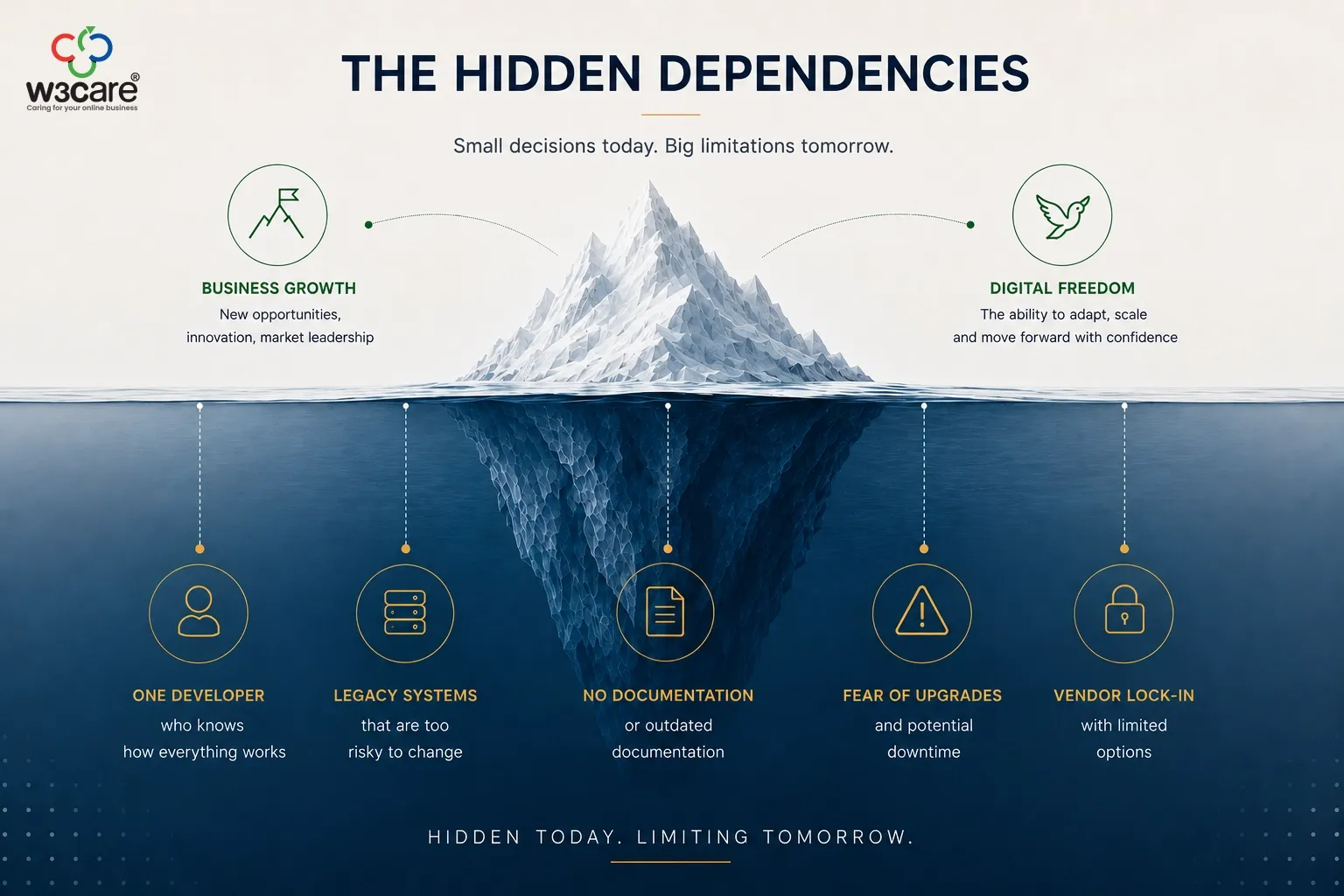
One of the most underestimated risks in technology is hidden dependency.
Not dependency on technology itself, but dependency on knowledge, people, and undocumented decisions.
Every long-running platform accumulates them.
The deployment process that exists only in one engineer's memory.
The integration that nobody has touched for years because “it's still working.”
The server that nobody feels comfortable restarting.
The CMS that has remained untouched because every update feels like a business risk.
Individually, these situations appear manageable.
Collectively, they create uncertainty.
And uncertainty changes how businesses make decisions.
Leaders postpone modernization.
Teams avoid improvements.
Budgets increase because every project begins with investigation instead of execution.
The technology may still be operating.
The business, however, has gradually lost confidence in changing it.
That is often the real cost of technical debt.
Technical Debt Is Really About Lost Freedom
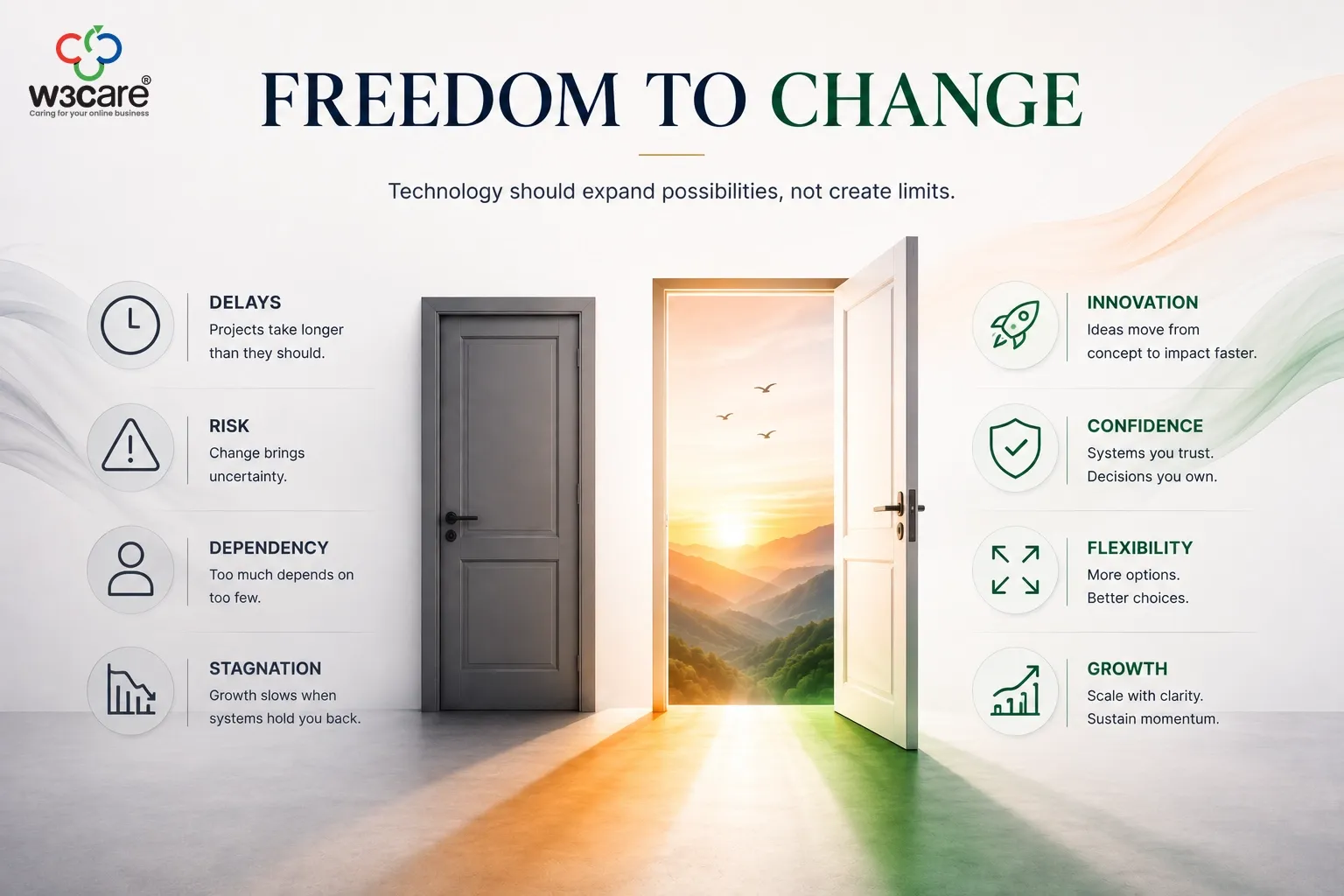
Technical debt is usually described as ageing software or outdated code.
From a leadership perspective, it is something much broader.
It is lost optionality.
It is every strategic decision that becomes slower, more expensive, or more uncertain because technology can no longer adapt at the pace the business requires.
That loss of flexibility also carries a business cost. A leadership framework for evaluating technology decisions can help organizations consider not only what a platform costs to purchase, but what it will require to operate, support and change later.
A modern business does not gain a competitive advantage simply because it uses newer technology.
It gains an advantage because its technology allows leadership to act decisively.
When digital foundations are healthy, organizations adopt new ideas with confidence.
When they are not, every change feels like a calculated risk.
The difference is rarely visible on a balance sheet.
It becomes visible in delayed launches, postponed innovation, increasing operational costs, and opportunities that quietly pass by.
Resilience Begins Long Before a Crisis
Business resilience is often associated with cybersecurity, disaster recovery, or incident response.
Those are all essential disciplines.
But resilience begins much earlier.
It begins with preparation.
Organizations that regularly modernize their platforms, document critical systems, review infrastructure, and test recovery processes are rarely doing those things because they expect failure tomorrow.
They do them because confidence is built long before it is needed.
One lesson repeatedly observed across business-critical digital platforms is that the organizations recovering fastest from disruption are not always those with the largest technology budgets.
More often, they are the ones that invested consistently in operational discipline.
Preparedness creates confidence.
Confidence creates resilience.
Resilience protects business continuity.
Technology alone cannot deliver that outcome.
People, processes, and governance matter just as much.
What Technology Leadership Should Really Achieve
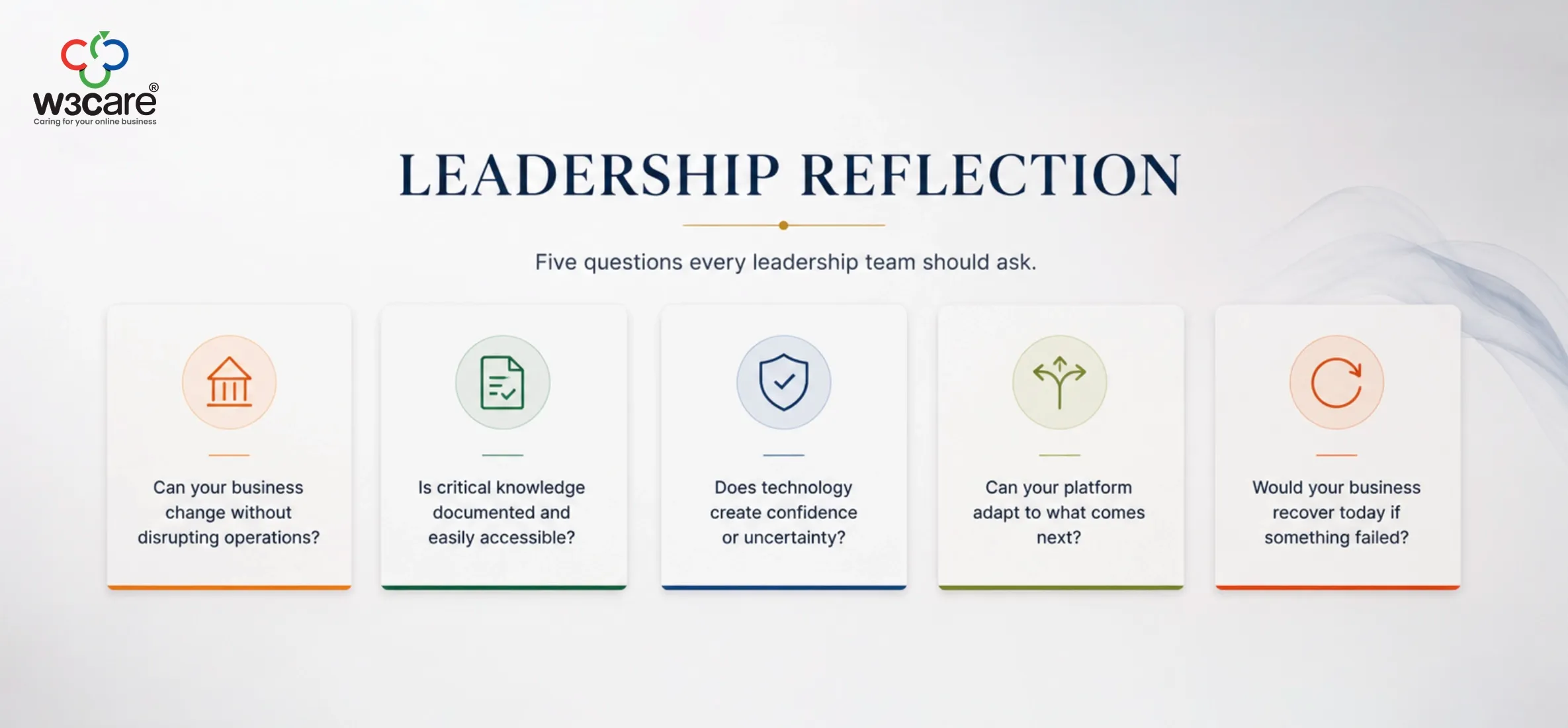
One misconception about digital independence is that it requires reducing reliance on external partners.
The opposite is often true.
The best technology partnerships increase independence.
A trusted technology partner should help an organization build systems that are easier to understand, easier to maintain, and easier to evolve.
Knowledge should become more accessible, not more concentrated.
Documentation should become stronger, not weaker.
Technology decisions should increase flexibility rather than create dependency.
Ultimately, the goal is not to make the business dependent on a technology partner.
It is to leave the business stronger because of the partnership.
That is the difference between delivering technology and building long-term capability.
A Different Way to Think About Independence
Every Independence Day reminds us that freedom is not preserved by a single moment in history.
It is protected through continuous investment, thoughtful leadership, and resilient institutions.
Businesses are no different.
Digital independence is not achieved through one software upgrade, one cloud migration, or one cybersecurity initiative.
It is built gradually through hundreds of decisions that make an organization more adaptable, more resilient, and more confident about the future.
Perhaps that is the most important leadership lesson technology can teach us.
Technology should never become something an organization fears changing.
It should become the foundation that gives leaders the confidence to pursue new opportunities, embrace innovation, and respond to uncertainty without hesitation.
Because in today's economy, the greatest advantage technology can provide is not speed.
It is freedom.
Leadership Takeaway

As we celebrate India's Independence Day, it is worth reflecting on the systems that support our own organizations.
Not to ask whether they are modern enough.
But to ask whether they leave the business free to grow, adapt, and make tomorrow's decisions with confidence.
Digital independence is not about owning more technology.
It is about ensuring that no single person, platform, process, or past decision quietly limits what your business can become.
That may be one of the most valuable forms of independence any organization can build.
- Beyond the Purchase Price: A Leadership Framework for Technology Decisions
- WordPress 7.1 Is Here: What Businesses Should Know Before Upgrading
- DDoS Attacks Are Getting Faster. Is Your Business Ready for the First 10 Minutes?
- Digital Independence: The Competitive Advantage Most Businesses Overlook
- Your Website Is Getting Traffic. Why Isn’t It Generating More Business?
- Your Website Is a Business Asset
- Still Running PHP 7.4? Upgrade Before It Costs Your Business
- How Businesses Are Being Targeted by Modern Cyber Fraud in 2026
- W3care Recognized as a Top Firm by 50Pros (Spring 2026)
- The Hidden Cost of Cheap Web Development