

Beyond the Purchase Price: A Leadership Framework for Technology Decisions
- Sep 17, 2026
- Satya P.
- Business, Custom Web Development
- 7 Mins. Read
Technology purchases are often compared using the costs that are easiest to see: license fees, implementation estimates and monthly subscriptions.
Those figures matter, but they rarely represent what the business will ultimately pay.
A platform may be inexpensive to purchase but expensive to operate. The difference may be absorbed through employee time, manual workarounds, unreliable integrations, delayed decisions, customer frustration and dependence on a system that is difficult to replace.
This leads to a more useful leadership question:
What will this technology require from the entire business throughout its useful life?
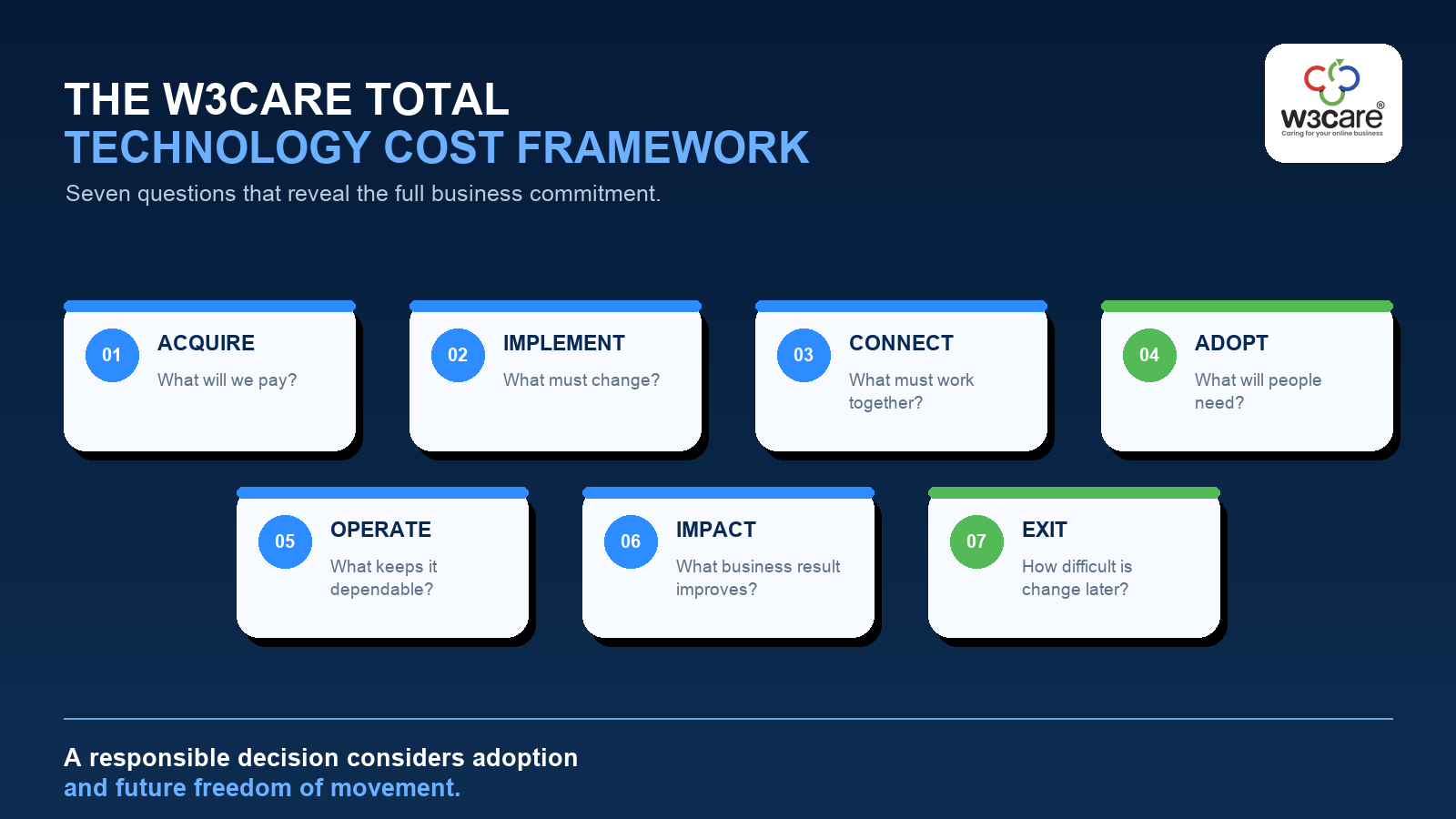
A technology decision should be evaluated across seven stages: acquisition, implementation, connection, adoption, operation, business impact and eventual exit.
The purchase price is only one part of the cost. The remaining burden may appear through operational complexity, customer friction, maintenance requirements and reduced freedom to change.
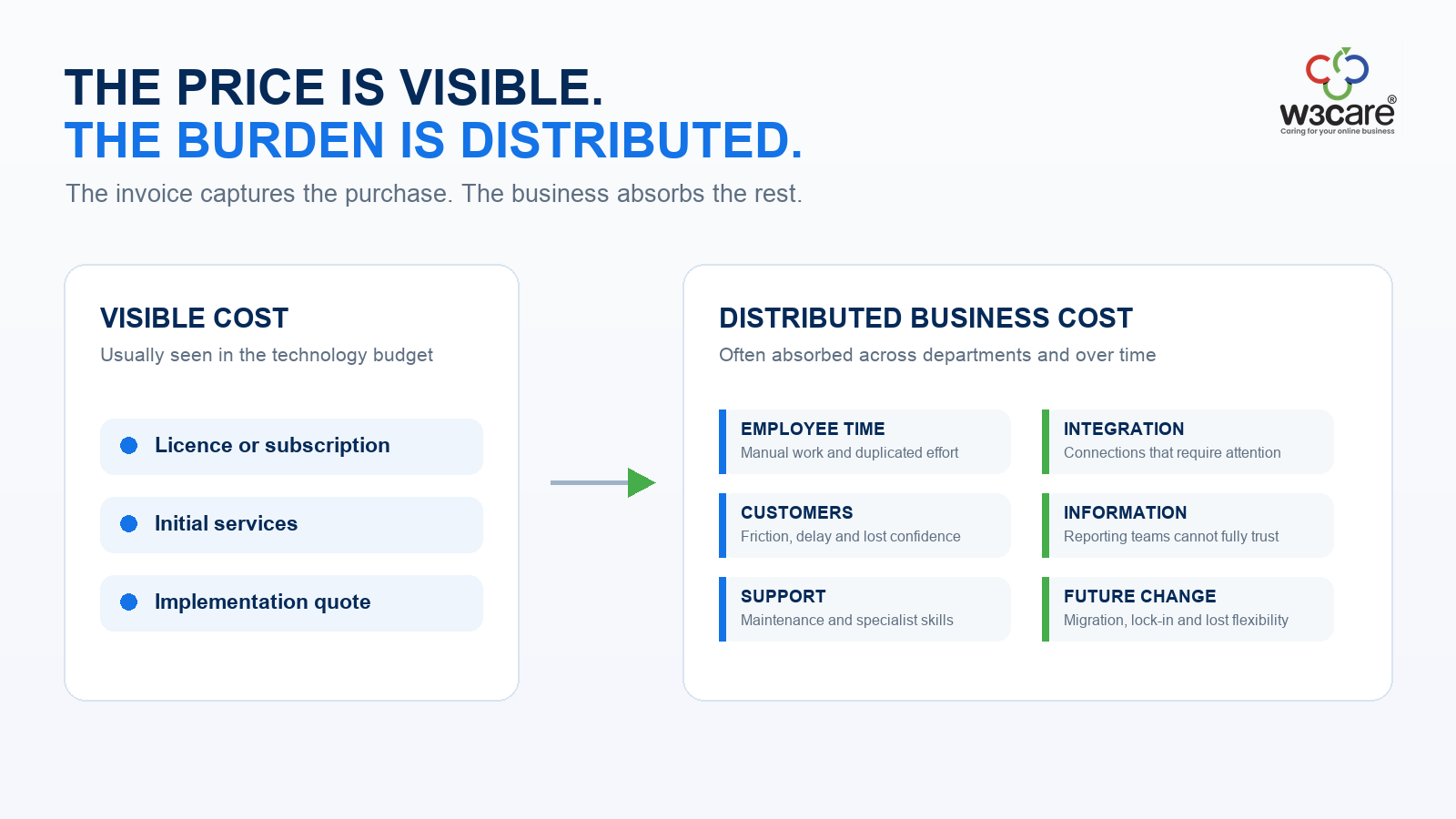
The Price Is Visible. The Burden Is Distributed.
Suppose a business chooses an affordable customer relationship management platform. It meets the immediate requirements and costs considerably less than the alternatives. Several months later, the marketing team discovers that campaign data does not transfer reliably. Sales employees begin maintaining separate spreadsheets. Finance manually reconciles reports. Customer service cannot see the complete history of an account.
These problems do not appear on the vendor’s invoice.
The platform may still look inexpensive within the technology budget, but other departments are now subsidizing its limitations with their time.
This is how an affordable product becomes an expensive business decision without producing a single dramatic cost increase.
Employee Time Becomes a Hidden Subsidy
When technology does not support a workflow properly, people compensate.
They copy information between applications, maintain additional spreadsheets, correct inconsistent records and build informal processes around product limitations.
A temporary workaround can be reasonable. The problem begins when temporary work becomes part of normal operations.
The cost is not limited to the hours involved. Manual work can also introduce delays, inconsistent results and dependence on the employees who understand how the workaround functions.
Before approving a system, leaders should ask:
- What work will the technology remove or create?
- Which teams will absorb any remaining manual work?
- What happens when the people managing those workarounds are unavailable?
Technology should reduce unnecessary effort. It should not quietly relocate that effort to another department.
Integration problems create operational complexity
No important business system operates entirely alone. Websites and digital platforms connect with customer databases, payment services, analytics platforms, marketing tools and internal applications.
An affordable platform may require customized integrations that need continuing maintenance. Information may move inconsistently, and different teams may see different versions of the same customer or transaction.
When standard platforms cannot support critical workflows, custom technology designed around the organization’s requirements may provide better long-term value than repeatedly working around product limitations.
Leaders should establish which systems must exchange information, whether dependable integrations exist, who will maintain them and how failures will be detected and managed.
Customer friction has a commercial cost
Technology limitations become commercial problems when customers experience them. A slow website, confusing checkout, unreliable account area or disconnected support process can affect conversion, retention, trust and reputation.
Customers do not separate the platform from the company. Two products may advertise similar features while producing very different experiences in practice. Saving money on the platform becomes a poor trade when the resulting friction makes it harder for customers to buy, receive support or remain confident in the organization.
Weak information leads to expensive decisions
Technology increasingly supports management decisions as well as operational work.
When a system creates inconsistent records or unreliable reporting, teams spend more time reconciling information and debating which numbers are accurate. The consequences can influence marketing investment, resource planning, revenue forecasts, product priorities and customer strategy.
Before choosing a platform, leaders should understand how information will be captured, validated and reported. A system that stores data does not necessarily produce dependable insight.
Support and maintenance shape the long-term cost
The quality of a technology decision often becomes clear after implementation. Leaders need to know who will resolve failures, whether dependable support is available and whether the system can be maintained without relying on one specialist.
For business-critical platforms, ongoing maintenance and technical support should be treated as part of the original investment—not as an expense considered only after problems appear.
The cost of leaving may be the largest cost
A technology decision becomes harder to reverse as the organization builds around it.
Data accumulates. Integrations multiply. Employees learn particular workflows. Other systems begin to depend on the platform. Eventually, replacing it becomes a significant business project.
Valuable technology naturally creates dependencies. Leadership should still understand whether those dependencies are reasonable and manageable.
Before selecting a platform, consider whether the organization can export its data, whether integrations are documented, whether another provider could maintain the solution and what a future migration would involve.
This ability to adapt is an important part of preserving digital independence, particularly as platforms become more deeply connected to everyday operations.
Good technology strategy plans for successful adoption while protecting the ability to change direction later.
The W3care Total Technology Cost Framework
Leadership teams can evaluate the broader cost of a technology decision across seven areas.
| Area | Leadership question |
| Acquire | What will we pay to access, license and procure the technology? |
| Implement | What will configuration, migration, testing and rollout require? |
| Connect | How reliably will it work with our existing systems and data? |
| Adopt | What must employees learn, change or continue doing manually? |
| Operate | What will support, monitoring, security and maintenance require? |
| Impact | How will it affect customers, productivity, revenue and decision quality? |
| Exit | How difficult and expensive would expansion, replacement or migration be? |
Apply the framework in proportion to the decision
Not every purchase requires an extensive assessment.
A small, low-risk tool should not be evaluated like a customer platform, ecommerce system or business-critical website. The depth of the review should reflect three questions:
- How important is the technology to daily operations?
- How much of the organization will depend on it?
- How difficult would the decision be to reverse?
The objective is not to slow every decision. It is to give important decisions the attention their consequences deserve.
A practical leadership review
Before renewing or replacing a significant platform, bring together representatives from technology, operations, finance and the teams that use it every day.
Ask them to identify:
- Manual work created by the current system
- Spreadsheets and processes maintained outside it
- Recurring integration or data-quality problems
- Support and maintenance effort
- Customer friction connected to the platform
- Decisions limited by unreliable information
- Dependencies that would make replacement difficult
This exercise can provide a more accurate view of cost than the contract alone. It also helps leadership distinguish between a platform that is genuinely economical and one whose limitations are being quietly funded by the rest of the organization.
The same principle applies to websites, where the hidden costs of poorly planned web development often appear through security, performance, maintenance and scalability problems.
Experience Changes How Technology Cost Is Evaluated
Across more than 1,500 digital projects, W3care has seen technology costs emerge in places that were not visible during procurement.
These costs can appear through undocumented integrations, difficult upgrades, manual operational work, unreliable reporting, platform dependency and systems that become increasingly difficult to change.
These experiences shape our approach to evaluating technology as a long-term business system rather than a one-time purchase.
The objective is not to recommend the most expensive solution. It is to help organizations understand the complete operational and commercial consequences of the available options.
The better question
The problem is not choosing an affordable solution. It is making the decision on purchase price alone.
Experienced technology leadership considers where costs will appear, who will absorb them and how the decision will affect the organization over time.
Before approving the next platform, application or digital initiative, ask:
Are we selecting the lowest-priced technology, or the technology that will create the best long-term value for the business?
If your organization is evaluating, renewing or replacing a business-critical platform, W3care can help assess the architecture, integrations, operational requirements and long-term dependencies before the decision becomes difficult to reverse.
- Beyond the Purchase Price: A Leadership Framework for Technology Decisions
- WordPress 7.1 Is Here: What Businesses Should Know Before Upgrading
- DDoS Attacks Are Getting Faster. Is Your Business Ready for the First 10 Minutes?
- Digital Independence: The Competitive Advantage Most Businesses Overlook
- Your Website Is Getting Traffic. Why Isn’t It Generating More Business?
- Your Website Is a Business Asset
- Still Running PHP 7.4? Upgrade Before It Costs Your Business
- How Businesses Are Being Targeted by Modern Cyber Fraud in 2026
- W3care Recognized as a Top Firm by 50Pros (Spring 2026)
- The Hidden Cost of Cheap Web Development