


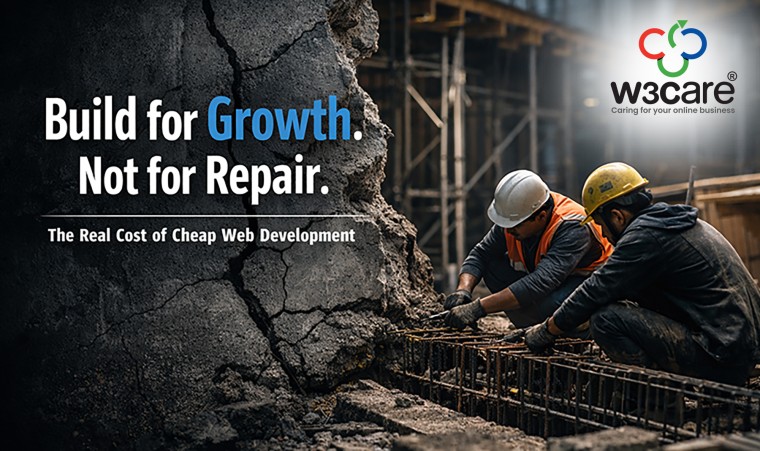
The Hidden Cost of Cheap Web Development
- Mar 24, 2026
- Tarachand
- Technology Strategy, Web & Application Development
- 3 Mins. Read
The Hidden Cost of Cheap Web Development
Cheap web development often feels like a smart decision. Lower upfront pricing, fast delivery promises, and packaged solutions make it attractive — especially for startups and growing businesses trying to manage budgets carefully.
But websites are not short-term expenses. They are long-term infrastructure.
And infrastructure built on shortcuts rarely stays cheap.
The Illusion of Upfront Savings
A low quote typically reduces visible costs — design hours, development time, testing, documentation, security hardening. On paper, everything looks fine. The website launches. The budget stays intact.
The real issues begin later.
When architecture is rushed or poorly planned, the site may rely heavily on third-party plugins, unoptimized themes, or loosely structured code. This creates technical debt — the accumulated cost of taking shortcuts today that demand more effort tomorrow.
Technical debt doesn’t announce itself loudly. It appears quietly as small problems:
- Updates breaking features
- Slow loading speeds
- Integration issues with CRM or payment systems
- Security warnings from hosting providers
Over time, these “small” issues compound.
Security Is Often an Afterthought
Low-cost development frequently skips deeper security considerations. Weak authentication practices, outdated libraries, improper role permissions, and missing server-level hardening leave the door slightly open.
And in cybersecurity, slightly open is enough.
A security breach doesn’t just cause downtime. It damages brand trust, search rankings, and customer confidence. Recovering from compromised data or malware cleanup often costs more than proper secure development would have in the first place.
Performance and SEO Erosion
Search engines increasingly reward speed, structure, and technical cleanliness. Bloated code, excessive scripts, and poor database optimization reduce performance. Even a one-second delay can affect conversions.
Cheap builds often focus on appearance over performance. The result? A site that looks polished but loads slowly under real-world conditions.
Search rankings drop. Bounce rates increase. Paid ads become more expensive because the landing experience is weak.
Suddenly, marketing costs rise — not because campaigns are bad, but because the foundation is unstable.
The Scalability Ceiling
Growth changes requirements. More traffic. More integrations. More content. More users.
If the original architecture was not designed to scale, expansion becomes painful. Adding new features requires rewriting old code. Performance degrades under higher traffic. Developers spend more time patching than building.
Eventually, businesses face a difficult decision: continue maintaining a fragile system or rebuild entirely.
Rebuilds are rarely cheap.
The Real Cost
The true cost of cheap web development is not just financial. It includes:
- Lost opportunities due to slow performance
- Reduced trust from security incidents
- SEO decline from poor technical foundations
- Internal frustration from constant fixes
- The expense of rebuilding within two or three years
What looked affordable at the beginning becomes expensive in stages.
A Better Way to Evaluate Cost
Website development is one part of a wider technology investment. Our Total Technology Cost Framework helps leaders assess what a platform will require to acquire, implement, integrate, operate and eventually replace.
Instead of asking, “What is the cheapest option?” consider asking:
- Is the architecture scalable?
- Is security built in from the start?
- Is the code maintainable and documented?
- Can this system support growth for 3–5 years?
A website should be an asset — not a recurring repair project.
Smart businesses understand that digital infrastructure is an investment decision, not a design purchase. When built correctly, a website supports marketing, operations, automation, and revenue growth.
Cheap development is not always wrong. But when price becomes the primary decision factor, long-term stability often pays the price.
Build once. Build intelligently. Grow without rebuilding.
- Can Machines Understand Your Business? The Question Every Leadership Team Now Needs to Answer
- Beyond the Purchase Price: A Leadership Framework for Technology Decisions
- WordPress 7.1 Is Here: What Businesses Should Know Before Upgrading
- DDoS Attacks Are Getting Faster. Is Your Business Ready for the First 10 Minutes?
- Digital Independence: The Competitive Advantage Most Businesses Overlook
- Your Website Is Getting Traffic. Why Isn’t It Generating More Business?
- Your Website Is a Business Asset
- Still Running PHP 7.4? Upgrade Before It Costs Your Business
- How Businesses Are Being Targeted by Modern Cyber Fraud in 2026
- W3care Recognized as a Top Firm by 50Pros (Spring 2026)